It’s a sunny Sunday morning. Most of the world is slowly rousing and you idly scroll through your phone’s social media feed. Your uncle has been very active online this morning.
You know, that uncle. The one you used to think was somewhat sensible until he started listening to AM talk radio and joined Facebook. The one that you’ve been considering Unfollowing for months now, but still feel could be saved. Even now as the memes he posts have crossed the border of racism and tribal factionalism, you still think one comment you make could make him see the light and put him on the right path once more.
He’s posted one of those memes that’s really just a screenshot of someone’s original post; no way to identify when it was originally posted, how many times it’s been shared, or even if the original post has been removed.
Your uncle has posted this:
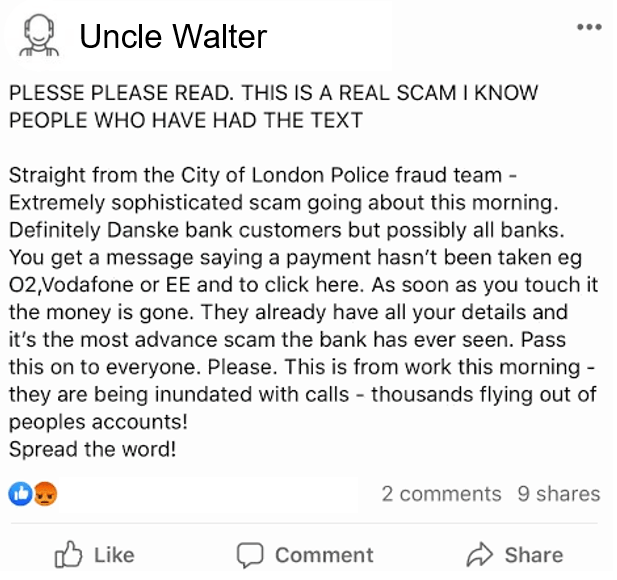
You spot straight away that it’s a hoax. Not the scam, but the warning itself. Part of you thinks your uncle posted this because he means well, but the more realistic side of you knows he’s posted this because he’s ignorant to the fact that phishing scams don’t work this way and he’s helping to spread a scaremongering meme that’s only going to serve to make even more people distrustful, confused, and possibly angry,
You read it again and realise it conforms to every aspect of the Urban Legends Formula that you heard about on a blog once, which is all the confirmation you need to know that the meme is bogus.
Just to be sure, you do a quick internet search and find that the City of London police has commented on this very meme six months ago.

So, you click Reply and write a nice and happy message to your uncle along the lines of ‘While it’s always good to be vigilant, you have nothing to worry about as this scam is not real. In fact, it’s like a scam scam, so nothing to worry about, as this scam is not real.’
For good measure, you add the link to the City of London Police’s tweet, and go on your merry way, to continue your mindless morning scrolling. You don’t expect him to respond. He never does.
Maybe 20 minutes have gone by and you watched a clip from last night’s Saturday Night Live, read the news about the 12,500 year old cliff painting found in Columbia and felt a little sad that the Monolith in Utah has been removed, when suddenly you see the same post from your uncle. Only, it’s not the same post. This time, he’s put the meme into your family’s Facebook Group.
You check the time stamp on this new post in the group and the time you added your comment to the original that he posted on his own feed, and you find that he added the meme to your family’s group after your comment informing him that it’s bogus.
Okay, so maybe he just hasn’t checked his notifications yet. You know what these older people are like.
So, you copy your comment on his original post and paste it into the comment feed in the group. Maybe you tweak it a bit first, expressing that you would like to reassure your elderly family members that they don’t have anything to worry about, there is no scam of this nature, and in fact the real scandal here is how viral this fake news is going.
There. That’ll do it. The world has been put right again. Time to look at the photos of the crazy Christmas decorations your old friend from school has been making.
And as you scroll, there it is again: Your uncle has put the meme into the local community Facebook Group that you’re both in. Surely he must have seen the comment on the previous posts. Even other people are commenting on those posts now, mostly agreeing with you that phishing scams don’t work as described in the meme.
Before you can comment on this third copy of the meme, you get a notification that your uncle has posted in another community group that you’re both in, and once again, it’s that same meme!
What is going on?
If this, or something similar, has happened to you, please know that you are not alone. And we think we may have stumbled upon a connection.
The science of Customer Behaviours is something that we have studied well in our career and your uncle’s behaviour is very similar to something we’ve experienced before.
James Heskett of the Harvard Business School developed a theory which was published in the Harvard Business Review under the title Putting the Service-Profit Chain to Work. Heskett explains that customer satisfaction will lead to a loyal customer and, following from data from customer satisfaction surveys, customers can be put into three different zones: The Zone of Affection, The Zone of Indifference, and The Zone of Defection. The two extremes of the customer are: The Apostle and The Terrorist.
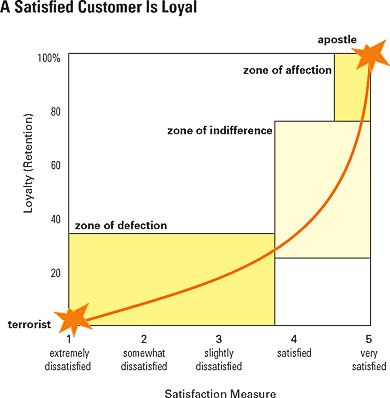
We all know some Apostles. Think about the Fan-Boy or Fan-Girl in your life. Maybe they really like Apple. Or maybe that can’t stop talking about Lululemon. But we all know some Terrorists as well. If you’ve ever run your own business, what were the Yelp reviews like?
A satisfied customer will go out and tell three people how great a brand or a service was. The people who find themselves in the Zone of Indifference won’t talk about the experience at all. But the dissatisfied customer will tell at least 10 people who terrible their experience was.
And this is how it is with the spread of Fake News.
The meme your uncle shared is designed to scare and it’s designed to be spread to as many people as possible. We’re already established that your uncle has had a shift in his beliefs, at least as they are expressed on Social Media.
Do you think your uncle might be dissatisfied with life? Could it be that with this technological world that’s popped up around him, possibly made him redundant from his job due to automation, is confusing and has made him feel like he’s lost control?
He might not choose to express it in such words, but your uncle is angry. He’s angry that the world has changed and there’s nothing he can do about it. He’s angry that there’s so much unemployment, especially in sectors that were such big employers in his youth, like manufacturing and production services. And the trouble is, the only place that he’s really found other people who are equally scared and angry as he is is on Facebook in easily manipulated groups. Those manufacturing jobs might have been sent overseas to Mexico and China in the 80s and 90s, but the memes he’s seeing on Facebook have him convinced that the Refugees coming into the country en masse have not only stolen all the welfare benefits, but stolen all the jobs as well.
So sucked up in this illogical logic, your uncle is convinced that there is a conspiracy to destroy the very fabric of the nation and that something had better be done to put us back to where we were, in long-forgotten better times that even he can’t quite put his finger on.
Your uncle is a dissatisfied customer of life. And he is ready and willing to share as much information as he can to make others just as angry as he is, even if some pesky youngster keeps trying to correct him.
Being a dissatisfied customer clouds one’s judgement. When the angry customer just sees red, it doesn’t matter what the company does to fix things. They could have given a full refund and offered a gesture of goodwill, but the angry customer will still warn you to never shop at that place. James Heskett’s advice is to ignore those customers and work on wowing the customers that you do have, because you can never win over the people who give you the lowest score on a satisfaction survey or multiple negative online reviews.
Your uncle, as a dissatisfied customer, most likely will never be convinced that the things that make him angry and which he keeps sharing might not be true. But this doesn’t mean that you should stop commenting. Your uncle may have some friends who are still in the Zone of Indifference when it comes to their media consumption. These people can either be swayed to the negative side or the positive side. They still have just enough of an open mind right now that your comment, which was rational and backed up by evidence, might just be the thing that keeps them from becoming an angry Fake News spreader.
So, as much as you might want to give up on your uncle, just think about how many people might be convinced to join him in what must be a miserable and angry period in their lives if you weren’t around to show them the light.
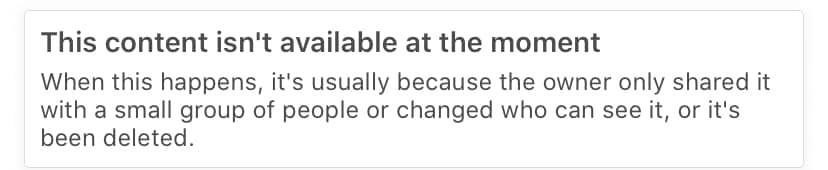
Besides, eventually your uncle’s post will do what they’ve all done lately: suddenly disappear and be replaced with:
By that point, your uncle has probably completely forgot what this particular meme was about, but it doesn’t matter, because he’s moved on to some Qanon or Plandemic meme now, anyway.
Just remember to keep being the light.
 Don't Believe Everything That You Meme