The United States 2020 election is just a couple of days away. Many are wondering what it will mean for America and for the rest of the world. But we are certain of one thing: Misinformation and manipulation online won’t go away. In fact, we will need to use our media literacy skills in the months and years to come possibly more ever before.
And the one thing we can be certain will not go away any time soon, and which in fact may intensify no matter the result of the election, is the internet troll.
In the last few weeks, Facebook has been purging fake accounts that serve only to troll American politics online. While some of these accounts were confirmed to be run by Russia’s Internet Research Agency, Facebook also targeted viral conspiracy group Qanon. But banning foreign trolls does not rid ourselves of the fact that many people have followed those professional trolls’ example and gleefully go online these days just to troll people with beliefs different to themselves.
You may have recently noticed your favourite actor or musical artist posting on social media about the fundraiser they are supporting in the run up to the election. The post might be done in a positive light, in the name of getting people to turn up to vote, but half the comments seem to be directed in anger, along the lines of: “I used to like your music, but now that I see from your politics that you are a traitor. YOUR RECORDS ARE GOING TO BURN!!”
But when you click on the commenter’s own profile, you find that they do not follow this particular artist. And then you go on to notice that multiple people are saying the same thing, as though it were a script, targeting their frustration at an artist that they believe should not be entitled to a political opinion, especially one that differs from their own. Probably the most humorous example of all of this is the recent comments of the ever-political band Rage Against the Machine:
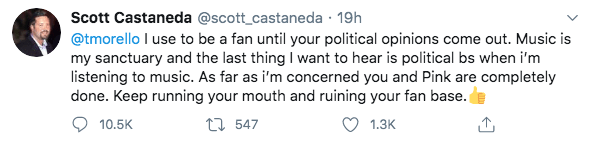
Trolls have a habit of being relentless. There is something about human behaviour that causes some people to want to attack others, especially when they know they are protected by a form of anonymity behind their screens and keyboards. Whether the troll feels compelled to respond out of a sense of cognitive dissonance to opinions or facts that differ from their own or whether its out of some form of perverse joy is a subject of much debate, but there does seem to be something about it all that’s predatory; the troll attacks primarily from a thrill of the hunt.
We have found that trolls come in two different flavours: Those that can be reached (if only temporarily) and those who are a lost cause.
Here is an example of a troll exchange that we witnessed in the days after the Trump impeachment. The names have been changed to protect the guilty.

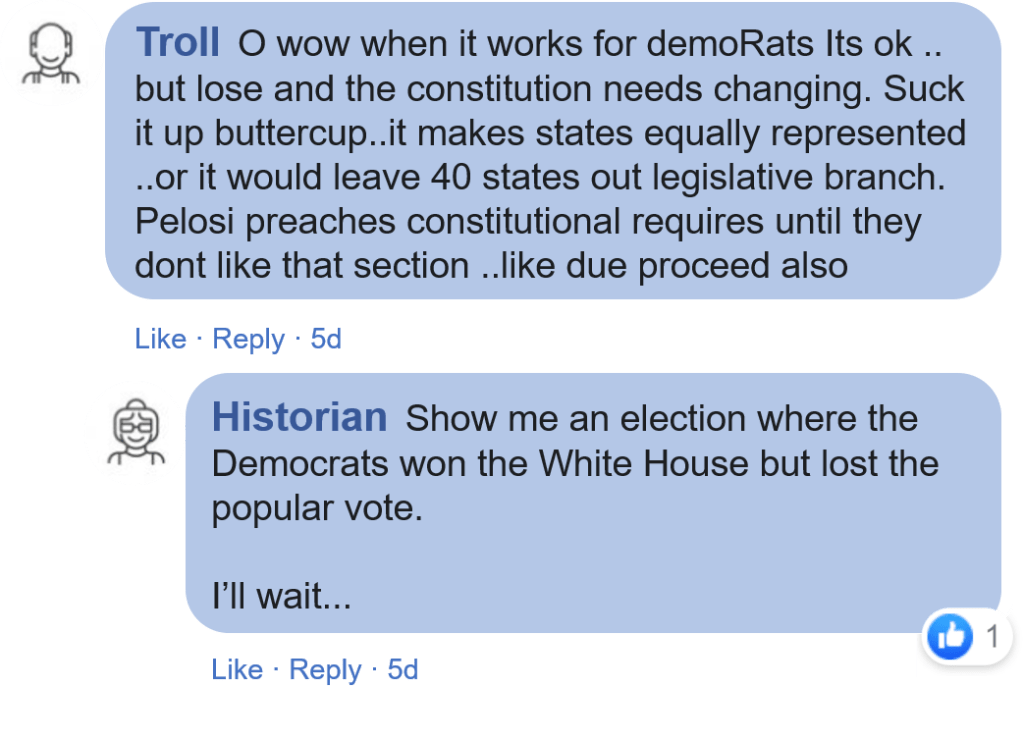
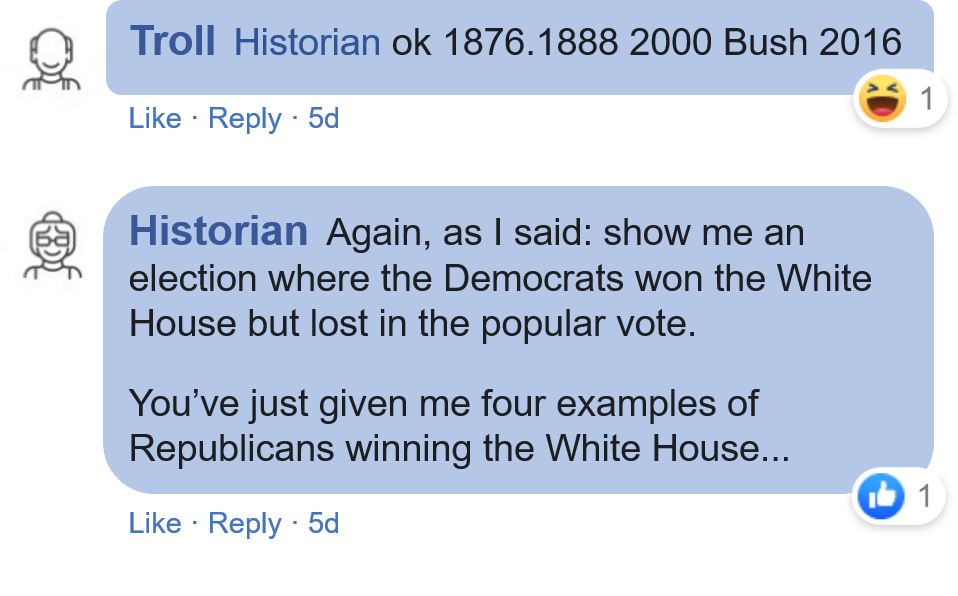

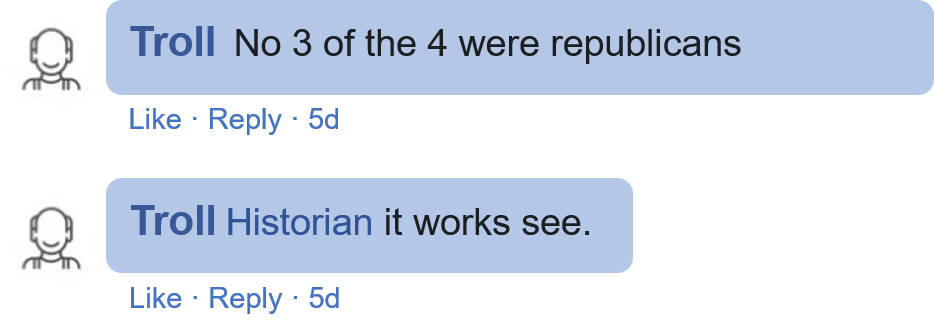
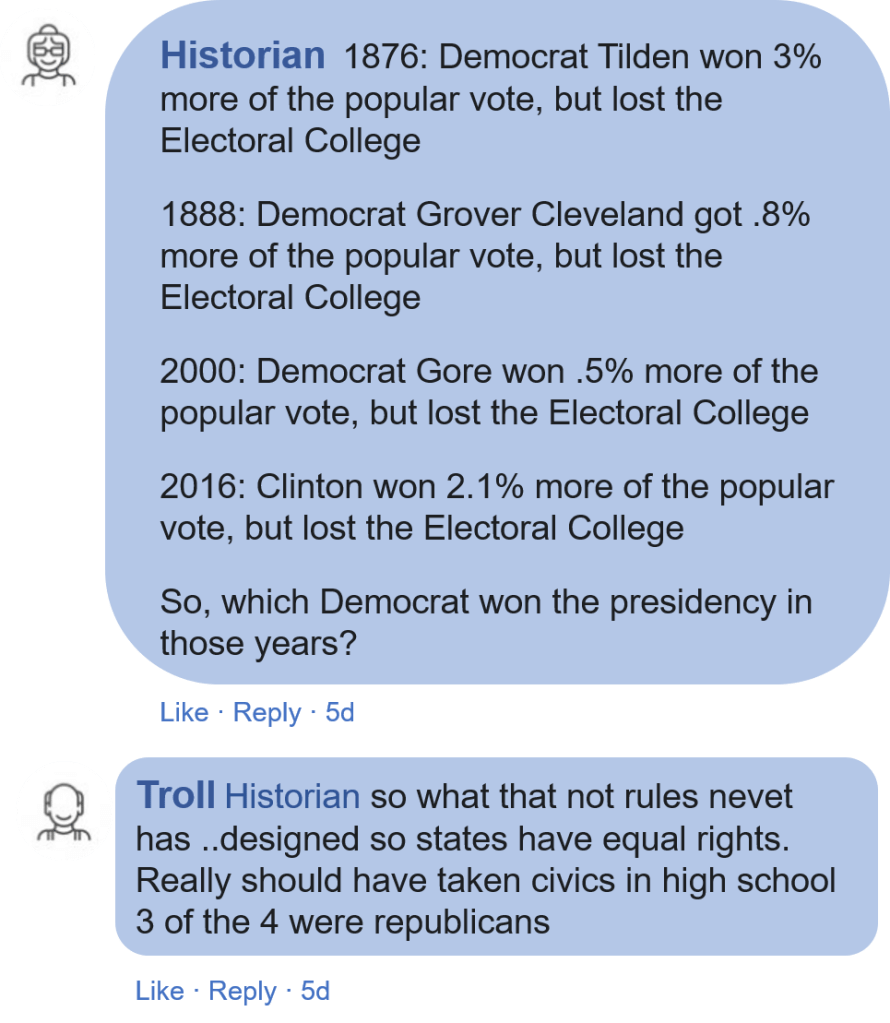
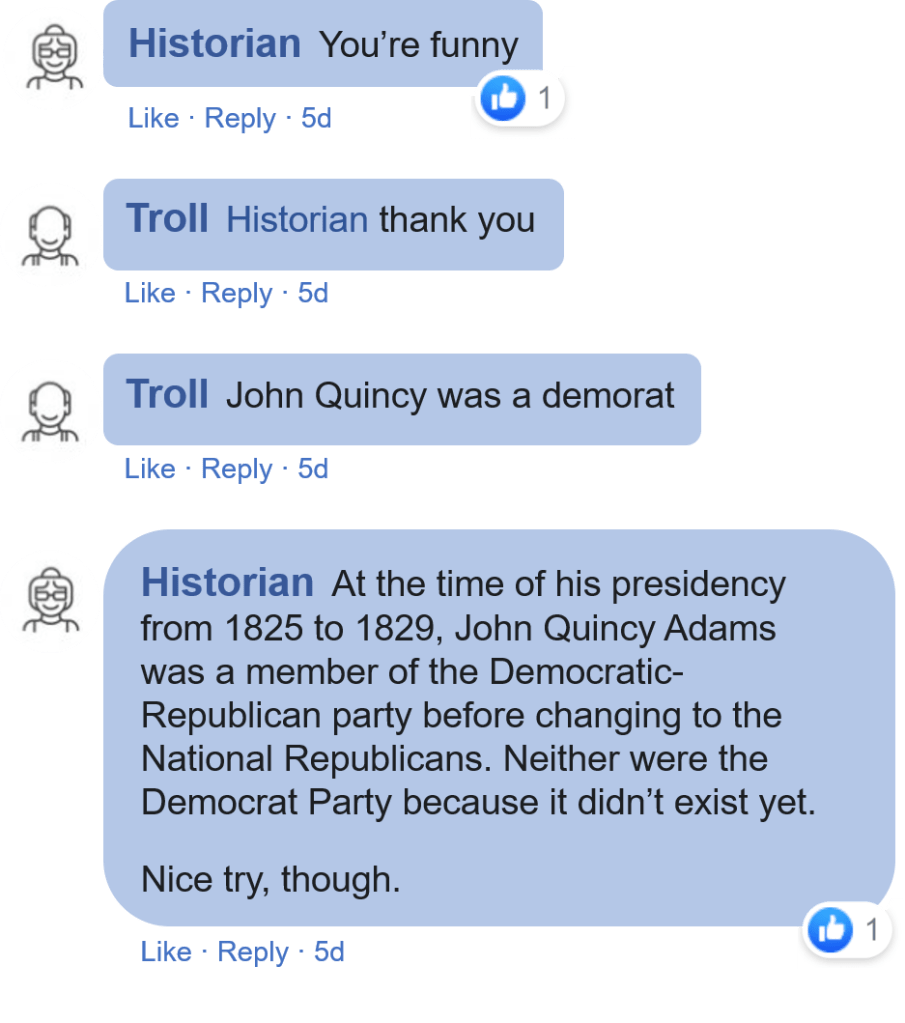
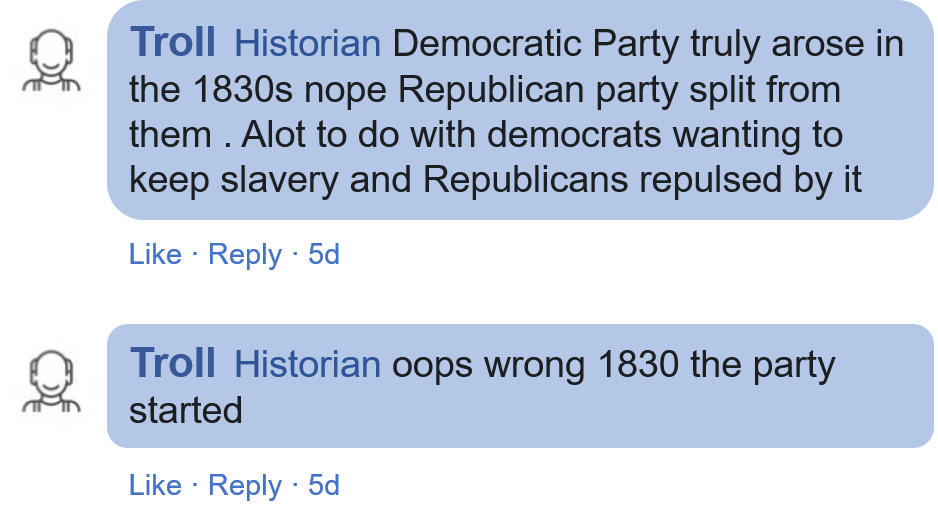
As you can see in this exchange, when presented with honest facts, the troll changes tactic, throws up some memes as a form of deflection from their failing argument, and then doubles down on their original belief, even as it’s being shown to be backed by faulty information. The one thing you may find surprising in this exchange is how the troll suddenly comes around at the end and recognises they have made a mistake. Their opinion is unlikely to have been fully changed, but the argument has been conceded.
So how was this done? And how can we do the same thing when the troll happens to be our own friend or family member? How do we deal with this when we know our own people are wrong and have been sucked down the rabbit hole of misinformation, without them feeling like they are being attacked?
With facts and figures, presented with integrity and empathy.
As you can see in the above exchange, at no point does the Historian descend to the level of attack from the troll. There’s no name calling or insults. The replies are calm and factual. There is no way the troll can argue with the logic presented here. The only thing that would have made the argument stronger would have been if the Historian had supplied some references that the troll could have used for definitive confirmation. If the Historian had gone on to attack the troll’s beliefs or character, as is the result in many an online argument, the troll would have felt that they had won, as often that is exactly the response they were likely looking for.
The troll thrives on division.
If the troll you are dealing with has any sense of rationality left, the way to win them over is to start with words that don’t sound like an attack. If you can get them to see that you are explaining facts from a place of love, you can disarm their hate. Try opening your comments with something like “I can see where you’re coming from, though you may wish to consider…”
By doing this, you can engage them in civil discourse, and if they are open to such a discussion, you may be able to convince them to see an opinion or a fact that is not shared in the own online bubble. You may even want to break out of your own bubble and see some of the news that they are seeing to really understand where they are coming from. Are all the references they share from fake and manipulative sources or are there any valid stories you might not have considered before? Is there anything in there that you can latch onto and build from?
You may find that your friend truly wants a conversation and may appreciate your attempts at civil engagement of differing opinions. Of course, others aren’t so open to having such a discussion and you may find that your friend has turned into an irrational troll whose angle will always be the opposite of yours, no matter what. When trying to deal with an irredeemable troll, one must first confirm that is what they are.
In May 2015, satirist Andy Borowitz published an article in the New Yorker titled ‘Scientists: Earth Endangered by New Strain of Fact-Resistant Humans.’ While the article focused on people who ignored climate scientists out of their strong cognitive dissonance rather than political viewpoints, the concept of Fact-Resistant Human suddenly opened up an idea of understanding for us.
For some people, critical thinking has gone completely out the window, fallen in a hole, been buried, and then paved over by three feet thick of concrete. There are people like this on all sides of the political spectrum who live in their confirmation bias bubble and have such powerfully held views, that seemingly nothing will ever break through the surface and resonate with them.
In Cass Sunstein’s book On Rumours: How Falsehoods Spread, Why We Believe Them, What Can Be Done, he describes how people can come to change their opinion on something when they hit a tipping point. It could be that all their friends are thinking one way and they go with the flow or it could be an influential person has a message that resonates in a way where others have not. With the first kind of troll, you can break through to them, but some people are so closed off that absolutely nothing will break through.
To help identify the too-far-gone troll, check to see if their arguments follow the Three D’s, which is a simple psychologically defensive path:
- Deny: Flat out deny the news and information presented to you; brush it off as ‘Fake News’
- Distract: Accept that something may have happened, but the news is blown out of proportion and it didn’t happen like people are saying
- Deflect: Concede that it happened, but who cares, because it doesn’t really matter.
You no doubt have recognised this pattern before, if not from online trolls, then certainly from politicians themselves.
After the whistle-blower exposed Trump’s Ukrainian scandal, prominent members of the Republican Party rejected the allegations at first. When the transcript came out, they changed tactics, accepting that the situation happened, but say that this wasn’t evidence of a quid pro quo like everyone was saying it was. Finally, after many hours of congressional testimony from witnesses who said that they president behaved inappropriately, these Republicans firmly stated that Trump did in fact do it, but it didn’t really matter, because he was their guy.
In the UK, it was a similar story for the Brexit Bus. Boris Johnson and his people at first denied that was ever a promise of the money being paid to the European Union being given to the NHS instead. Eventually they admitted that maybe they did make that promise, but that they planned to do it in a different way. After the High Court found the Vote Leave team guilty of lying and misleading, Boris and his team did concede that they made such a promise, but it wasn’t going to happen, so everyone should just get over it.
If our politicians behave this way, it should come as no surprise when our uncles behave this way as well. While the politician is playing a game with the media, this doesn’t mean that we shouldn’t try to reach our friends and family when they behave in the same way.
If you find, after days, weeks, or months of trying to be the positive influence in their lives by presenting facts and figures with integrity and empathy, and still they stand their ground, exhausting their Three D’s argument and calling everyone names and slinging insults, it’s time to consider everyone’s sanity. This troll is too far down the rabbit hole and it is probably best to resign yourself to the fact that you have found one of the Fact-Resistant Humans. Nothing will ever make them change, even when their world is crumbling down upon them, because they have been so manipulated to the point that this misinformation has been programmed into their code and cannot be erased.
Yes, this is not the most positive of outcomes. We want so much to believe that we can redeem the trolls in our lives, snap them out of it and make them come out the other side. And maybe for some of them, you can. But there are times when we must take a pause and work out whether the energy we are expending is really worth it.
If we come to the conclusion that it is not, it is important to remember that there is an unfollow button, both in social media and in real life. This person wishes to remain in the echo chamber that is their own internet bubble, where they firmly believe that they are in the majority, and there is nothing more we can do than to cut them off. Perhaps if they are isolated from dissenting views, they will calm down. But probably not.
Sometimes we just have to let go.
 Don't Believe Everything That You Meme